Writing the first version of this article with a coding agent took 47,290 tokens. In one long Codex session, a single later status check processed about 296,000 raw tokens. The useful edit had already been made; the extra tokens came from invoking the model again to handle asynchronous test and deployment status. I moved that post-edit work into CI.
What CI is, in one paragraph
CI stands for continuous integration: a server runs your tests and builds your project automatically whenever the code changes. On GitHub the mechanism is GitHub Actions. You push a commit or merge a pull request, GitHub matches the change against a workflow file in the repository, and a machine called a runner executes the commands listed in that file. Those commands are ordinary shell commands. No language model is invoked to start a job, to wait fifteen seconds, or to read back a status. When a runner polls an API for ten minutes, the cost is CPU time.
How this site is set up
rajeevg.com is a Next.js site deployed by Vercel. It has a workflow called Article local CI. The three parts do different jobs:
- GitHub is the trigger and the status layer. It notices that a
content/posts/**file changed, starts the workflow, and displays whether each job passed. - A self-hosted runner on my Mac does the compute. Installing dependencies, running the test suite, building the site and driving a browser all happen locally.
- Vercel builds and serves the public site. CI does not deploy; it waits for Vercel and then checks the result.
There are two acceptance paths. On a pull request, CI installs dependencies, runs the broad test suite, builds, and proves the article renders in a real browser against the local build. After merge to main, CI does the same work and then waits for Vercel's deployment of that commit, waits for the live URL to serve the page, and runs the browser proof against production.
What the authoring agent does now
The agent that writes an article has a bounded job:
- Write or change the article file.
- Run only the targeted checks that inform the next edit, such as validating the MDX.
- Commit.
- Emit a marker in its final message:
CI_HANDOFF. - Stop.
CI_HANDOFF is a convention, not a product feature. It tells my orchestration layer that the model's turn is finished and everything after this point belongs to CI. The agent does not ask GitHub whether the workflow started, and it does not check Vercel.
The exact work that moved out of the model
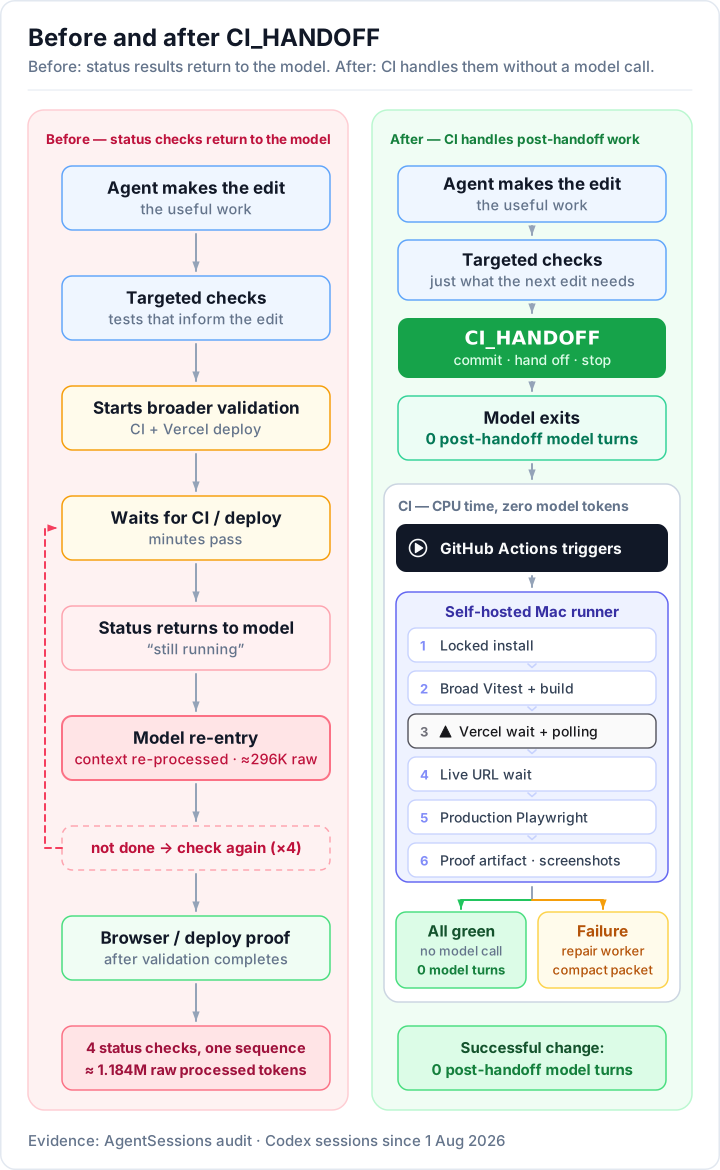
After the handoff, all of this runs without a model call:
- install locked dependencies with
pnpm install --frozen-lockfile - run the broad Vitest regression suite
- run the production build
- poll GitHub every fifteen seconds until Vercel reports the deployment for that commit as successful, or fail after fifteen minutes
- retry the live article URL until it serves the page
- run the Playwright browser proof against the production URL
- capture screenshots and upload them as a build artifact
- record the job as green or red
These steps are deterministic. A normal runner can execute them without invoking a language model.
Why this saves tokens
The saving comes from avoiding model re-entry. If Codex checks an asynchronous job, the returned status has to be processed by the model. That model call includes the accumulated session context: instructions, files read, edits, tool results and previous turns. A small status update can therefore cause a large amount of context to be processed again.
CI changes that mechanism. GitHub Actions and the self-hosted runner poll status, run tests and inspect exit codes with ordinary programs. If everything succeeds, no model is called after CI_HANDOFF. The amount saved depends on how many model re-entries the old workflow would have caused and how large the session context had become.
What my session records show
I checked 632 Codex sessions recorded since 1 August 2026. Across them, I found 612 model responses whose only purpose was to process a wait result. Those wait-only responses averaged about 127,000 raw processed tokens each.
The cost rises as the session gets longer. In one clean GitHub Actions example late in a long session, four status-check model turns processed about 1.184 million raw tokens in total, or about 296,000 per check. The new CI path removes those successful status-check turns entirely.
For completeness, the underlying audit covered 20,632 tool calls, including 4,557 waits. The 612 wait-only responses processed about 77.75 million raw tokens in total. Most of that input was cached, so these figures describe context processing and quota use, not the equivalent number of freshly billed tokens.
Where the tokens went
Why a small status check can process a large context
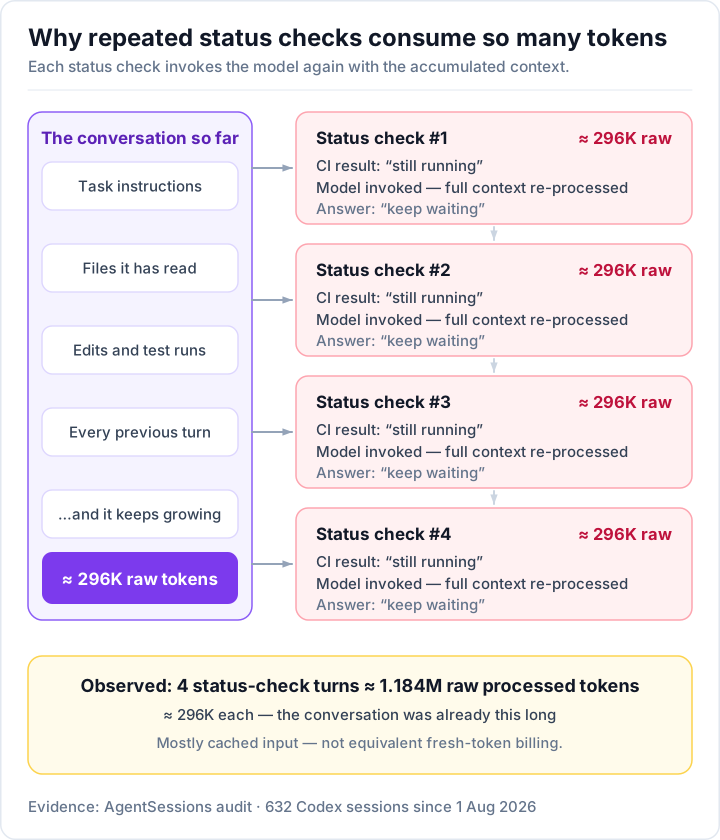
That gives a useful estimate for a publication task. If the old publish/deploy tail would have caused three to five model re-entries, moving it into CI avoids roughly 380,000 to 635,000 raw processed tokens at the audit-wide average. In a long-context session like the observed four-check example, the same three to five avoided re-entries are roughly 890,000 to 1.48 million raw processed tokens.
Which tasks stopped needing a model
| Work after handoff | What CI does | Rough saving if it avoids model re-entry |
|---|---|---|
| Broad tests and production build | Runs Vitest and next build, then reads the exit codes | One avoided result-check turn is about 127K raw tokens at the audit average, or about 296K in the observed long session |
| Vercel deployment wait and live-URL readiness | Polls deployment status and the URL on fixed intervals | If this removes 1–3 status-check turns, about 127K–381K at the audit average, or 296K–888K in a long session like the observed example |
| Production Playwright proof and artifact upload | Runs the browser proof and stores the evidence | One avoided result-check turn is again roughly 127K average / 296K long-context |
Those are estimates based on avoided model re-entries, not intrinsic token prices for Vitest, Vercel or Playwright. The important change is that successful post-handoff work now requires zero model turns.
Before and after
Before and after CI_HANDOFF
This article as the test case
The first version of this piece was written by a GPT-6 Astra worker at low reasoning. It finished in 2 minutes 56 seconds, used 47,290 tokens, committed, emitted CI_HANDOFF and stopped. It never polled GitHub and never looked at Vercel.
CI took it from there. The rewrite pull request run took 2 minutes 49 seconds. The production run after merge took 6 minutes 7 seconds: waiting for Vercel, running the broad suite and the build, then driving a browser over the published page and uploading the screenshots. The most recent proof artifact was about 3.28 MB.
An earlier production run also exposed a real CI bug. The workflow watched GitHub check-runs, while Vercel was publishing the deployment result as a commit status, so CI timed out even though deployment had succeeded. The workflow now checks both APIs. The failure appeared as a red job with logs; the authoring model did not need to stay active to detect it.
What this does and does not prove
This is not a controlled experiment. I did not run matched publishing tasks down the old and the new path and measure the difference, so I am not claiming a percentage saving. What is observable is the architecture: the writing model now stops before several minutes of installing, testing, building, deployment waiting and browser proof, and that work runs where waiting costs CPU seconds.
The metric I will watch is simple: for a successful change, model tokens spent after CI_HANDOFF should be zero. If CI fails, a repair worker can be started with the commit, failed job and relevant output. If CI succeeds, no further model call is needed.
This does not make CI a replacement for the coding agent. The agent still writes, reasons and runs targeted checks while editing. CI takes over the deterministic work that happens after the useful edit is complete.