Most "AI browser agent" writing stops at the idea: the model looks at a page and clicks things. The interesting part is the plumbing underneath, because that is where agents either stay safe or quietly click the wrong button.
This is a walk through the actual path I run: Jev Ultrafast deciding what to do, driving my own logged-in Chrome through either Playwriter or Browser Relay. Same loop, two very different transports.
The core rule: the model picks a number
The whole design rests on one constraint. The model never sees or emits a selector, a coordinate, or a line of JavaScript. It gets handed a menu of things the page says are clickable, and it returns one index from that menu.
That is the entire output of a decision. Not "click the submit button" — something closer to CLICK [7], where [7] was a real element the code found and numbered a moment earlier.
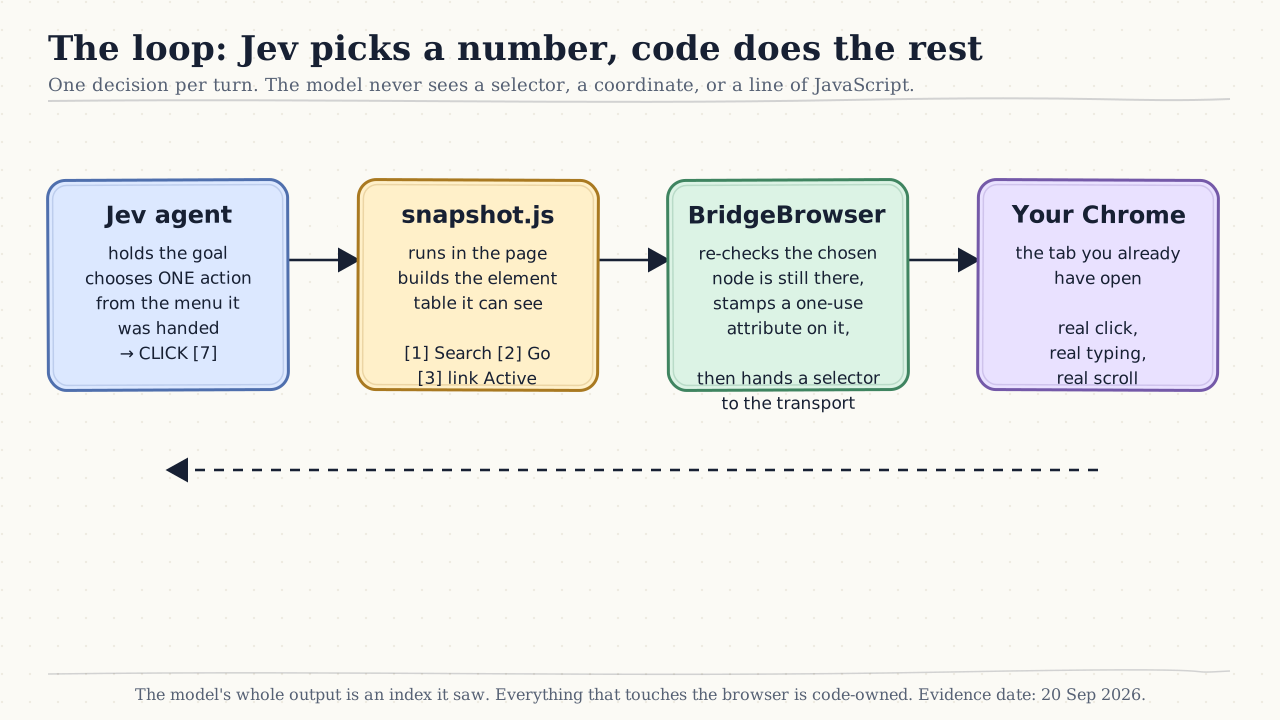
One decision per turn. The model's entire output is an index it saw; everything that touches the browser is code-owned. Download the editable Excalidraw source.
Step 1 — observe
A small script (snapshot.js, shipped with Jev) runs inside the live page. It walks the DOM, keeps only things a human could actually interact with, and builds a table: label, role, current value, whether it is checked, enabled, visible.
The same script also attaches a per-node guard — a fingerprint of that specific element's identity, role, text and state — plus a page key covering the URL, scroll position, viewport, and every field's value. Those two things are what make the next steps safe.
Step 2 — decide
That table goes to Jev, along with the goal and the last few actions. Jev picks one operation and one target from the table. This is a genuinely small decision — the model is choosing from a menu it was just handed, not reasoning about DOM structure.
The output is an index. CLICK [7].
Step 3 — re-validate, then act
This is the part that matters, and it is why the model cannot click the wrong button.
Before anything touches the browser, the bridge re-checks the chosen node. Not "does a button with this text exist" — that is the fragile approach — but "is this exact element still the thing I numbered."
Four checks, in order:
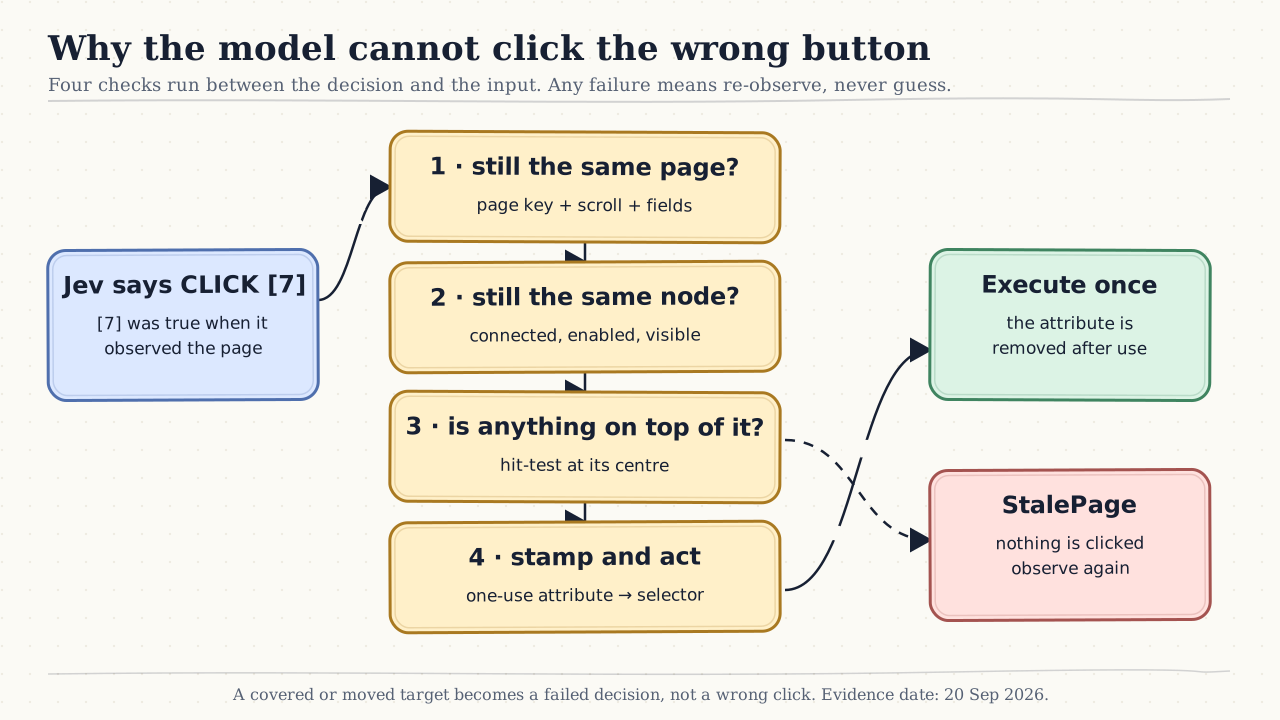
A covered or moved target becomes a failed decision, not a wrong click. Download the editable Excalidraw source.
If all four pass, the bridge stamps a one-use attribute on the element — a random token, data-jev-fast-target="jev-<uuid>" — and removes any previous stamp. The transport then acts on that generated selector, not on anything the model produced. The attribute is one-use by construction: it is retagged on every action, so a stale token cannot be replayed.
If any check fails, nothing is clicked. The bridge raises a stale-page error and the loop simply observes again. A decision that was true two seconds ago is discarded rather than trusted.
There is one subtlety worth naming, because it cost me real time: the cheap "has the page changed?" probe deliberately does not re-serialise the whole page. An early version re-ran the full snapshot just to compare freshness, which doubled the work per decision and inflated exactly the latency I was trying to measure. Safety does not depend on it — the per-node guard is the real check — so the freshness probe was replaced with a short identity tuple.
Two transports, one interface
Everything above is transport-independent. The bridge holds a small interface:
navigate · evaluate · click · fill · key · scroll
Two implementations satisfy it. Which one you get is a single environment variable: JEV_BROWSER_BACKEND=browser-relay or playwriter.
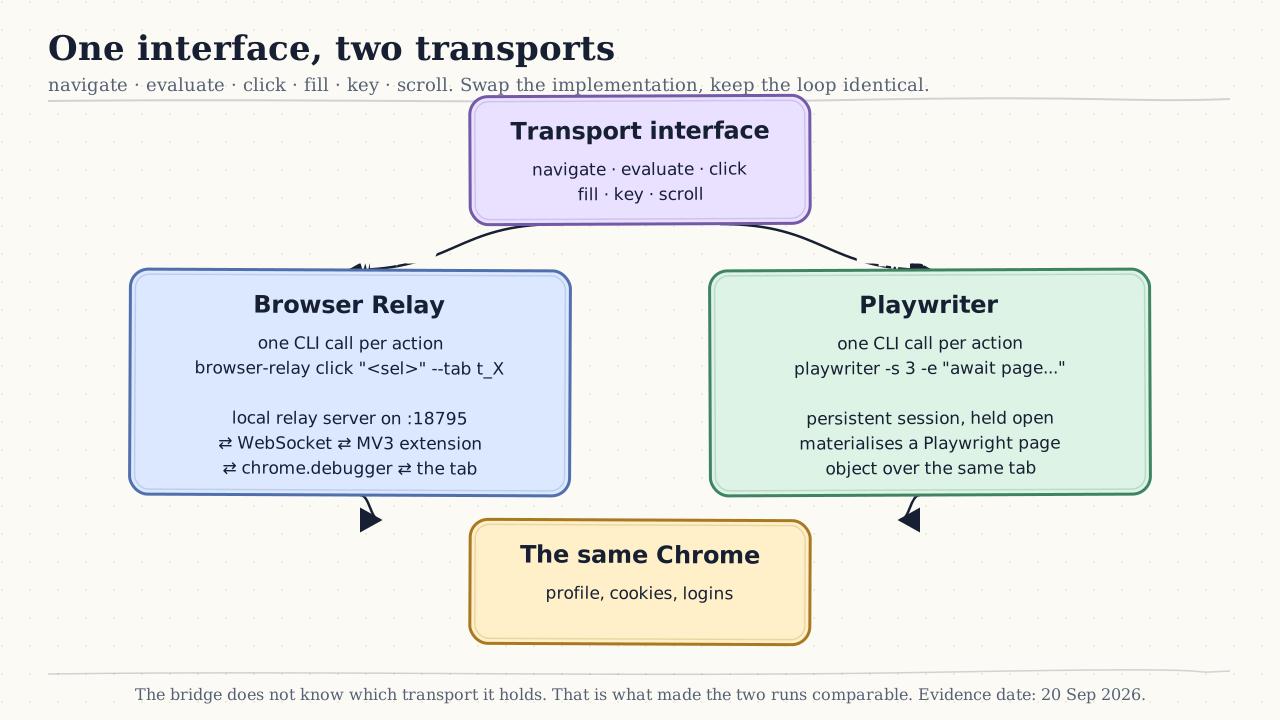
Both drive the same logged-in Chrome. The bridge does not know which one it holds. Download the editable Excalidraw source.
Jev + Browser Relay
Browser Relay is a CLI that talks to a local relay server, which holds a WebSocket to a Chrome extension, which uses the chrome.debugger API to drive the tab. Every action is one process:
browser-relay click '[data-jev-fast-target="jev-9f2c…"]' --tab t_M0X65KrUJQ
browser-relay type 'Email supplier' --selector '[data-…]' --clear --tab t_M0X65KrUJQ
browser-relay eval "$(snapshot_js)" --tab t_M0X65KrUJQ
The bridge picks a tab by asking the relay for its attached tabs and matching the target host, falling back to the first tab if nothing matches. You can pin it explicitly with BROWSER_RELAY_TAB.
One practical wrinkle I hit: the relay drops keyboard input when the attached tab is backgrounded. Pressing Enter into a tab that is not focused silently does nothing, which looks like a broken agent when it is actually a focus problem. Focus the tab before a run. I verified this directly — with the tab focused, Enter committed the item three times out of three; unfocused, zero out of three.
Jev + Playwriter
Playwriter is the other shape. It holds a persistent session with a real Playwright page object over your Chrome tab, and each action is a small snippet of JS evaluated in that session:
playwriter -s 3 -e "await page.locator('[data-jev-fast-target=\"jev-9f2c…\"]').click()"
playwriter -s 3 -e "await page.keyboard.press('Enter')"
playwriter -s 3 -e "console.log('__JEV_JSON__' + JSON.stringify(await page.evaluate(...)))"
Because a real page object exists, the transport maps directly onto Playwright's own API: locator(...).click(), locator(...).fill(...), keyboard.press(...), mouse.wheel(...). The evaluate path is slightly more indirect — the expression is passed as a string and executed with an indirect eval, and the result is returned through a __JEV_JSON__ marker on stdout, because the CLI's output is text and the value has to survive the trip.
What the difference actually costs
Both transports spawn a process per action, which is the dominant per-action overhead. Measured on my machine, one spawn costs roughly 42 ms for browser-relay and 109 ms for playwriter — the Node startup for the Playwriter CLI is heavier.
That is a real architectural difference, and it shows up in the numbers. Over five runs each on the same task with the same decision policy, Jev on Playwriter finished with a median of 16.1 seconds (4 of 5 passing) and Jev on Browser Relay 13.1 seconds (5 of 5). Same decisions, same browser, different plumbing underneath — and a measurable difference in what it costs to make each one.
Why build it this way
Three properties fall out of this design, and they are the reason it is worth the wiring.
The model cannot invent a target. It answers with an index. If it hallucinates [999], no such node exists and the action fails closed. There is no syntax for "click the thing near the other thing."
A stale decision is a failed decision. The guard is re-checked immediately before input, so the window between deciding and acting is the only window that matters. On a page that re-renders — which is most real pages — this is the difference between an agent and a lottery ticket.
The transport is swappable. Because the bridge only depends on the interface, I could run the identical decision logic over two completely different browser stacks and compare them honestly. A result measured over one transport is a result about the policy, not about the transport's quirks.
That last property is what made the comparison in my browser automation benchmark possible: when you want to know whether a fast decision model helps, you have to hold the browser fixed and change only the decider. This bridge is what lets me do that.
The honest limits
- Jev's policy is a separate service. The decisions here come through classifier.dev, whose fast tier is Jev; the direct TypeSafe path needs its own key. Same decision model, different endpoint.
- A process per action is not free. Both transports pay Node startup per step. A transport with a persistent socket and no subprocess boundary would remove that cost entirely — that is the obvious next step, not a solved problem.
- Focus still matters for keyboard input on the relay path, as noted above.
- Everything here is small-n. The numbers quoted are from a handful of runs on one controlled task, and should be read as a strong signal rather than a settled result.
If you want the code, it lives in jev-tests: src/jev_tests/bridge.py for the bridge and both transports, and src/jev_tests/classifier_policy.py for the decision policy.